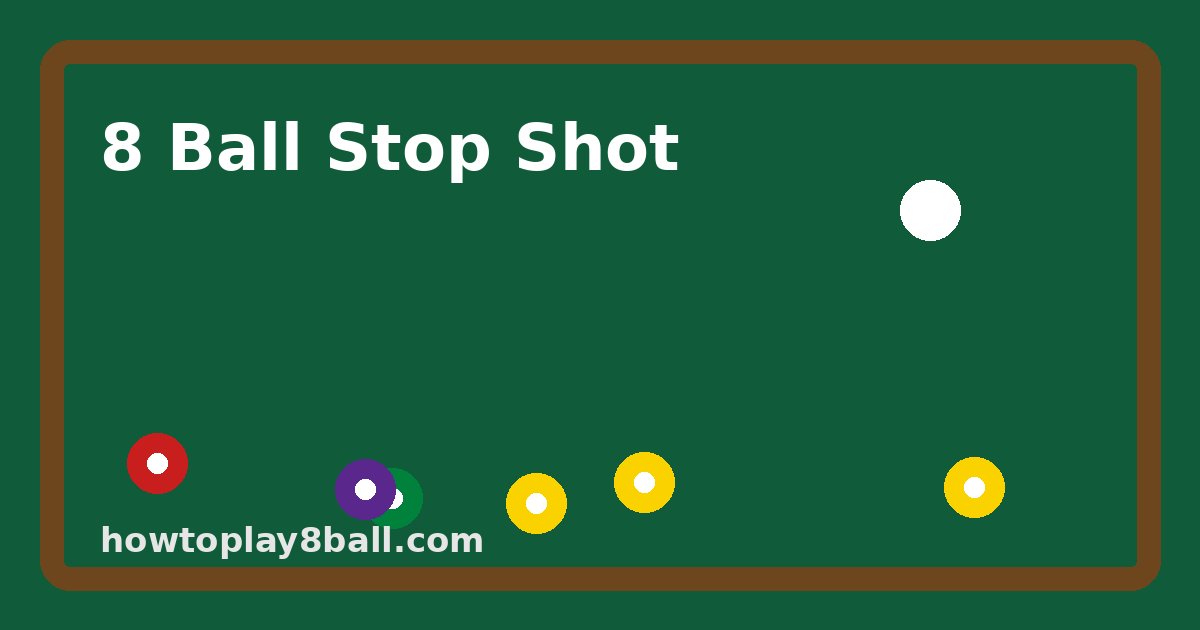
Quick answer: A stop shot in 8 ball is when the cue ball stops dead right where it hits the object ball. It only works fully on a straight in shot. To hit one, aim a little below the center of the cue ball so it is sliding, not rolling, when it hits the object ball. The farther the cue ball has to travel, the lower you need to hit it or the firmer you need to shoot. The stop shot is one of the first cue ball control shots every 8 ball player should learn.

When the cue ball stops in place, you know exactly where it will be for your next shot. That makes it a great tool for position play.
Why the Cue Ball Stops
When a sliding cue ball hits an object ball straight on, it passes almost all its speed to the object ball and stays put. If the cue ball is rolling forward when it hits, it follows. If it is spinning backward, it draws back. A stop shot is all about getting that sliding hit.
How to Hit an 8 Ball Stop Shot
- Line up a straight in shot. Start with the object ball about a foot from a corner pocket and the cue ball about a foot behind it.
- Aim a little below center. For short shots, just below center may be enough.
- Use a smooth, level stroke. Keep the cue as level as you can.
- Follow through. Do not stab at the ball.
- Watch the cue ball. If it rolls forward, hit lower or a bit firmer. If it draws back, hit a little higher.
How Distance Changes the Shot
The cue ball picks up natural roll as it travels across the cloth. So:
- Short distance: hit just under center at medium speed.
- Medium distance: hit lower.
- Long distance: hit lower and a bit firmer so the backspin is not gone by the time the cue ball arrives.
When to Use a Stop Shot in 8 Ball
Good times to stop the cue ball:
- When your next ball is easy from where the cue ball is now.
- When you want to avoid a scratch in a pocket behind the object ball.
- When the cue ball might run into a cluster if it follows or draws.
- When you want a simple, safe shot under pressure.
Stop Shot vs Stun Shot
On a cut shot, the cue ball cannot stop dead. If it is sliding when it hits, it goes off at about a right angle to the line of the object ball. That is called a stun shot. It uses the same hit as a stop shot. So once you learn the stop shot, you are also learning the stun shot.
Practice Drill
Put the object ball one diamond from the corner and the cue ball one diamond behind it in a straight line. Shoot five stop shots. Then move the cue ball back one more diamond and repeat. Keep going until you are at the far end of the table. Note how much lower you need to hit as the distance grows.
Common Mistakes
Watch out for:
- Hitting too low and drawing back.
- Hitting too high and following.
- Jumping up off the shot.
- Hitting too soft on long shots so the backspin wears off.
Put It in Your Game
The stop shot helps you plan simple routes through the rack. Combine it with smart 8 ball position play and good 8 ball shot selection. Then try it in your 8 ball practice drills each week until it feels natural.
Keep Reading on This Site
- 8 Ball Cut Shots: How to Aim Thin and Thick Cuts and Make More Balls
- How to Play 8 Ball Pool: 7 Simple Steps for Beginners
- 8 Ball Strategy for Beginners: 7 Simple Ways to Win More Games
- 8 Ball Break Rules: What Makes a Legal Break and What Happens Next
- How to Break Up Clusters in 8 Ball: 6 Simple Ways to Free Stuck Balls
- Scotch Doubles 8 Ball: How It Works and How to Win as a Team
Frequently Asked Questions
What is a stop shot in 8 ball?
It is a shot where the cue ball stops in place right where it hits the object ball, which only fully happens on a straight in shot.
Where do you hit the cue ball for a stop shot?
Hit a little below center so the cue ball is sliding, not rolling, when it reaches the object ball.
Why does my cue ball roll forward on a stop shot?
It had picked up forward roll before contact. Hit a little lower or shoot slightly firmer.
Can you do a stop shot on a cut shot?
Not fully. On a cut, the same hit makes a stun shot, where the cue ball goes off at about a right angle.
When should I use a stop shot?
Use it when your next ball is easy from the current spot, to avoid scratches, or to keep the cue ball away from clusters.